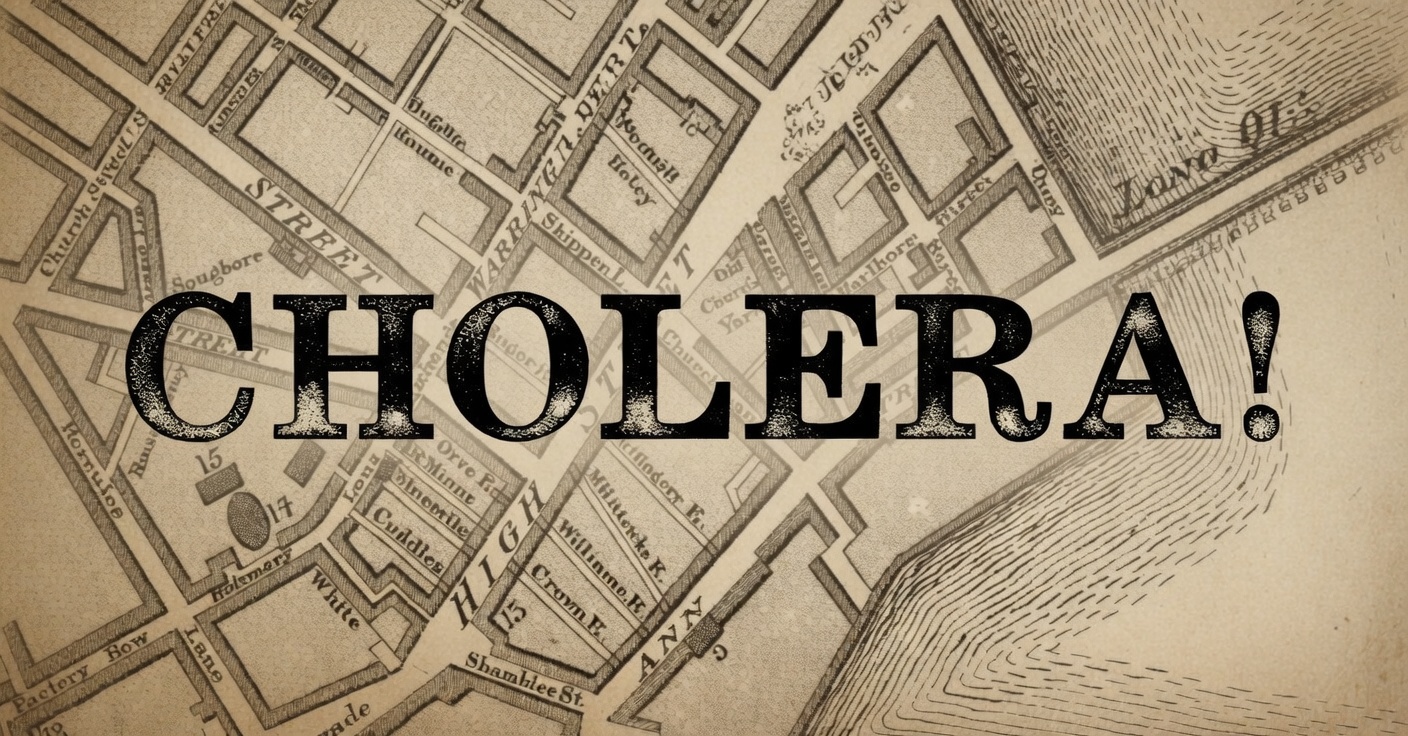
This timeline details the first arrival of Asiatic cholera in Belfast, an event that represented a critical moment in the history of Irish public health administration. While many areas of Ireland suffered some of the most severe per capita mortality, Belfast's rates were significantly lower by comparison, with relative success arguably achieved through the early establishment of preventative measures.
| Category | Details |
|---|---|
| Official Chronology | 25 September 1831 – November 1832 (with residual cases extending into 1834) |
| Initial Local Outbreak Site | No. 14 Quay Lane: A high-density lodging house situated near the banks of the River Lagan. 28/29 February 1832 |
| Potential Transmission Vector & Environmental Risks | Cross-channel maritime trade with Scotland, e.g., the arrival of repatriated paupers removed from areas where cholera had been present. Many landed at the nearby ports of Bangor and Donaghadee. Local transmission was likely accelerated by environmental conditions including poor sanitation and overcrowding. |
| Institutional Response | Creation of Belfast Board of Health in advance of cholera's arrival. Town split into six medical districts supervised by board members. A temporary cholera hospital erected behind the Belfast Fever Hospital in Frederick Street, supplemented by quarantined isolation houses on Lancaster Street. Belfast Corporation intensified street cleaning and nuisance removal efforts. Houses of those most in need were whitewashed and fumigated, with food, clothing and new bedding also provided. |
| Statistics | Peak Period Spring–Autumn 1832 – 2,831 cases – 418 deaths. Mortality 14.8% |
| Notable Deaths | 11 July 1832, Dr William Buchanan, physician to the Ballymacarrett cholera hospital, was the only Belfast doctor reported to have died from cholera during the epidemic. The Belfast Newsletter noted that he had worked almost without rest, had left no provision for his wife and five children, and called for public subscriptions to support them. |
| Key Events |
• Belfast Charitable Society agrees to shut its Poorhouse at the earliest sign of cholera, effectively quarantining the institution (no subsequent cases of cholera were recorded), June 1831. • Belfast Board of Health first established, 25 September 1831 (made official 22 November 1831). • Establishment of temporary Cholera Hospital, February 1832. • First unofficial case, 28 February 1832. First unofficial death, 29 February 1832 (19 hours after first symptoms). • First Official Death, 18 March 1832. • 9–15 June 1832: Cholera fears sparked a brief nationwide panic centred on the "blessed turf" phenomenon, following rumours of a Marian apparition in Charleville, Co. Cork, where ashes were said to protect against disease; the practice spread through most of Ireland (including parts of Ulster) but caused little violence and was later dismissed as a mass supernatural delusion or hoax. • Epidemic escalates, mid-late June 1832. • Epidemic Peaks, 8-14 July 1832. • Belfast Newsletter final report on statistics, 20 November 1832. • Cholera Hospital Closed, 16 December 1832. |
© Dr Nigel Farrell — This work is shared for research and educational purposes. Any reuse, quotation, or reproduction must include appropriate academic attribution to the author. The content may not be redistributed commercially without permission. Full licence details →