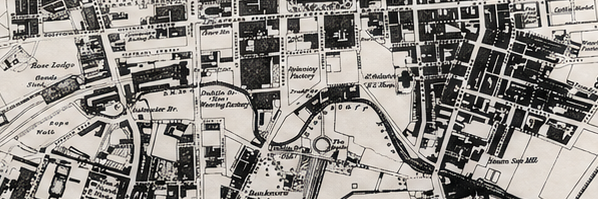
This timeline traces some of the key developments in Belfast's public health history across the nineteenth century. It follows the journey from early philanthropic efforts and piecemeal responses to poor sanitation, through recurring fever epidemics and the devastating impact of cholera, to the arrival of the Poor Law and the eventual consolidation of sanitary powers under the 1878 Public Health Act. Progress was slow and often driven by crisis. Yet each emergency pushed Belfast towards a more systematic and coordinated approach to public health.
| Category | Details |
|---|---|
| Official Chronology |
1774–1800: Early philanthropic provision; Poorhouse (1774) and Dispensary (1792). 1800–1820s: Piecemeal by-laws; fever epidemics; Blackstaff pollution emerges. 1831–1834: First cholera epidemic; Board of Health formed pre-emptively. 1838–1841: Irish Poor Law; Workhouse opens with beds for sick. 1845–1849: Famine fevers and second cholera; Sanitary Committee formed. 1851–1855: Medical Charities Act; third cholera epidemic. 1855–1865: Chancery Suit paralyses reform. 1865–1866: Water famine and final cholera epidemic. 1874–1878: Public Health Acts consolidate sanitary powers. |
| Early Philanthropic and Civic Provision (1774–1820s) |
1774 – Belfast Poorhouse opens; Belfast Charitable Society oversees operation. 1792 – Belfast Dispensary founded, offering free medical care to the poor. 1800 – Belfast Police Act creates Commissioners of Police for street cleaning and nuisance removal. Overlapping jurisdictions limit effective sanitary progress. 1800–1820s – Rapid population growth driven by industrialisation creates overcrowding, inadequate housing, and worsening sanitation. 1816–1819 – Severe fever epidemics affect an estimated 7,400 people. Fever Hospital opens in Frederick Street (1817). 1818–1819 – Fever Hospital (Ireland) Act and Contagious Diseases (Ireland) Act establish early state intervention in Irish public health. 1820s – Blackstaff River becomes increasingly polluted with industrial and domestic waste, emerging as a major public health hazard. |
| Fever, Cholera, and Civic Response (1831–1838) |
1831 – Belfast Board of Health formed pre-emptively. Town divided into six medical districts. 1832 – First cholera epidemic: 2,831 cases, 418 deaths (14.8% mortality). Mortality lower than Dublin (31%) and Cork (33%). Dr Henry McCormac introduces strict isolation policy at the cholera hospital. 1834 – Cholera hospital closes; emergency sanitary measures fade. 1838 – Irish Poor Law introduced; first structured system of state welfare and institutional health intervention. |
| Poor Law, Town Improvement, and Famine Crisis (1838–1849) |
1841 – Belfast Workhouse opens. Guardians set aside beds for the sick, departing from Poor Law policy. 1845–1847 – Town Improvement Acts expand powers for paving, drainage, sewerage, and nuisance removal. 1845–1849 – Famine migration drives severe outbreaks of fever and dysentery. 1847 – Approximately 2,500 Belfast residents die from fever and dysentery. 1848 – Dr Andrew Malcolm's report on Belfast's sanitary condition leads to formation of the Belfast Sanitary Committee. 1848–1849 – House-to-house inspection and cleansing programmes introduced. 1848–1849 – Second cholera epidemic: 3,538 cases, 1,163 deaths. 1849 – Public concern focused on persistent flooding and contamination associated with the Blackstaff. |
| Medical Charities, Sanitary Reform, and Failures (1850s) |
1851 – Medical Charities Act reorganises Ireland's dispensary system. 1852 – Malcolm's The Sanitary State of Belfast catalogues urban deficiencies. Of 12,902 houses, 4,047 lack rear accommodation, 4,326 have no drainage, and 6,179 are without privies. Malcolm estimated life expectancy at birth in the poorest districts at approximately nine years, reflecting extreme infant and childhood mortality. 1852 – McCormac condemns the Blackstaff as a polluted open sewer, "worse than the London Fleet." 1853 – Rev. William Murphy O'Hanlon publishes Walks Among the Poor of Belfast. Rev. Anthony McIntyre's diary records conditions among the city's poorest inhabitants. 1853–1855 – Third cholera epidemic: 1,871 cases, 677 deaths (36% mortality). 1855 – John Rea's Chancery Suit exposes major financial irregularities and contributes to a prolonged slowdown in sanitary reform. |
| Water Famine and Final Cholera (1860s) |
1864 – Sanitary administration strengthened; permanent inspector appointed. Samuel Browne becomes Medical Officer of Health. 1865 – Severe drought causes a major water famine. Reservoirs fail and contaminated water is widely used. 1865 – Registrar General records 334 fever deaths. 1865 – Joseph Watt links rising fever mortality directly to water shortage and contaminated supply. 1866 – Sanitary Act expands local authority powers and formalises dispensary-based sanitary administration. 8 August 1866 – First confirmed cholera case recorded at Bridge End, Ballymacarrett. 1866 – Only 28 cholera cases and 15 deaths recorded in Belfast. 11 September 1866 – Authorities address continuing nuisances associated with the Blackstaff and Pound Burn. |
| Consolidation: Public Health Reform (1874–1878) |
1872 – Local Government Board for Ireland established. 1874 – Public Health (Ireland) Act introduces Urban Sanitary Authorities. 1878 – Public Health (Ireland) Act consolidates powers relating to drainage, sewerage, housing, water supply, and disease prevention. |
| Post-1878 Developments |
1879 – Public washhouses open at Peter's Hill, long advocated by Andrew Malcolm. 1880 – Samuel Browne becomes Belfast's first Medical Superintendent of Health. 1880–1881 – Hercules Street clearance creates Royal Avenue and removes a major overcrowded district. 1880s–1890s – Progressive culverting of the Blackstaff as part of wider sewerage and urban improvement schemes. Further schemes were carried out in the twentieth and twenty-first centuries. 1889–1890 – Infectious Diseases (Notification) and (Prevention) Acts strengthen disease surveillance and control. 1901 – Luke Livingston Macassey completes first stage of the Mourne water scheme, supplying Belfast with 10 million gallons per day. |
© Dr Nigel Farrell — This work is shared for research and educational purposes. Any reuse, quotation, or reproduction must include appropriate academic attribution to the author. The content may not be redistributed commercially without permission. Full licence details →